
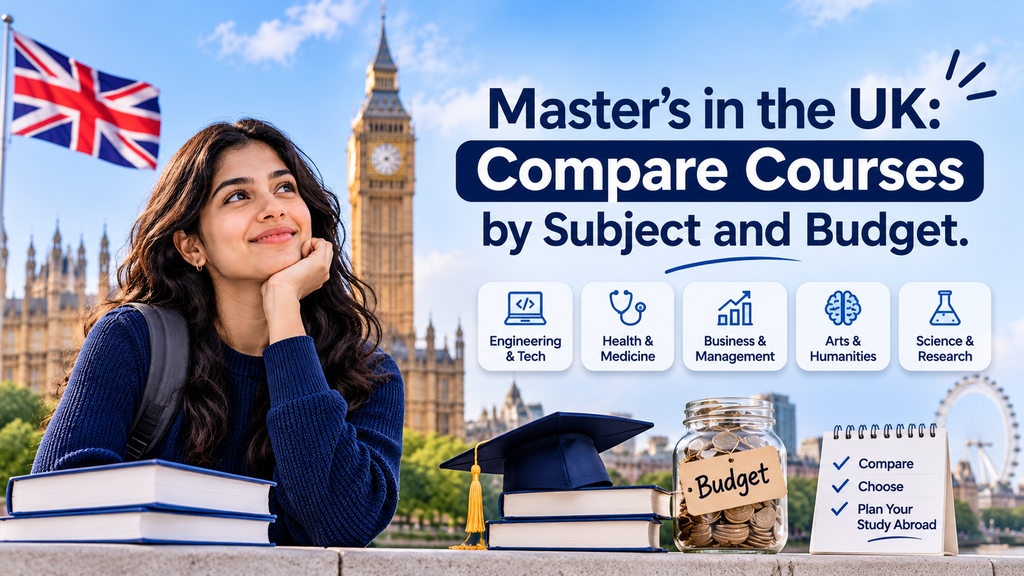
Choosing the right postgraduate programme is one of the most important decisions for international students planning to study abroad. The UK is a popular destination for students seeking internationally recognised qualifications, specialised academic programmes and opportunities to develop professional skills.
However, with hundreds of universities and postgraduate programmes available, selecting the right course can be challenging. Tuition fees, course duration, subject specialisation and admission requirements differ between universities.
This guide to Master’s in the UK explores popular subject areas, programme types, study durations, tuition fee comparisons and entry requirements to help international students make informed decisions.
1. Master’s in the UK: Different Types of Postgraduate Programmes
UK universities offer different postgraduate qualifications depending on students’ academic backgrounds and career objectives.
The main programme types include:
- MA (Master of Arts): Suitable for subjects such as English, International Relations, Education, History and Humanities.
- MSc (Master of Science): Focuses on technical and scientific subjects such as Data Science, Computer Science, Finance and Engineering.
- MBA (Master of Business Administration): Designed for students interested in business management, leadership and organisational development.
- MRes (Master of Research): Focuses on independent research and academic investigation.
- MPhil (Master of Philosophy): A research-oriented postgraduate qualification that can also provide a pathway towards doctoral studies.
Students should compare the programme structure and career relevance before selecting a qualification.
2. Master’s in the UK: Popular Courses by Subject
Choosing a subject based on academic qualifications, professional interests and future career plans is essential.
Here are seven popular subject areas international students can explore:
1. Business and Management
Business-related postgraduate programmes include International Business, Marketing, Human Resource Management and Project Management. These courses develop knowledge of organisational strategy, leadership and business operations.
2. Data Science and Artificial Intelligence
Data Science, Artificial Intelligence, Machine Learning and Business Analytics are relevant options for students interested in technology and data-driven industries.
3. Computer Science and Cybersecurity
Students interested in software development, network security, cloud computing and information technology can explore specialised MSc programmes.
4. Engineering
Mechanical, Civil, Electrical and Renewable Energy Engineering programmes offer advanced subject knowledge and technical specialisation.
5. Healthcare and Public Health
Popular options include Public Health, Healthcare Management, Clinical Research and specialised healthcare programmes. Some clinical programmes require relevant professional registration or previous experience.
6. Finance and Accounting
Students interested in financial services can consider MSc Finance, Accounting, International Banking and Financial Management.
7. Education and Social Sciences
Education, Psychology, International Development and Social Policy are suitable options for students interested in academic, research and social development careers.
3. Master’s in the UK: Course Duration and Study Options
One important advantage of UK postgraduate education is the availability of different study formats.
| Programme type | Typical duration |
|---|---|
| Full-time taught Master’s | 1 year |
| Part-time Master’s | 2 years or longer |
| Research Master’s | 1–2 years |
| MBA | 1–2 years |
| MPhil | Often 1–2 years |
Most full-time taught Master’s programmes in the UK take approximately one year to complete. However, actual duration depends on the university, qualification and programme structure.
Students should check whether the programme includes an internship, placement year, dissertation or additional research component.
4. How Much Does a Master’s in the UK Cost?
Tuition fees are an important factor when comparing UK universities. The total cost depends on the chosen subject, university, location and programme duration.
For initial planning, students can use the following illustrative annual tuition budget bands. These are comparison estimates, not fixed or official UK fee ranges.
| Subject area | Indicative annual tuition budget |
|---|---|
| Arts and Humanities | £12,000–£20,000 |
| Business and Management | £15,000–£25,000 |
| Data Science and IT | £15,000–£28,000 |
| Engineering | £16,000–£28,000 |
| Healthcare and Public Health | £14,000–£25,000 |
| Finance and Accounting | £16,000–£28,000 |
| MBA | £18,000–£40,000+ |
Important: Always verify the exact international tuition fee on the university’s official course page. Some specialised programmes and prestigious institutions charge considerably more.
Students must also budget for accommodation, food, transportation, healthcare surcharge, visa fees and other personal expenses.
According to GOV.UK, the current Student Visa financial requirement is £1,529 per month for courses in London and £1,171 per month outside London, for up to nine months. These are immigration maintenance requirements, not estimates of actual living expenses.
Source: https://www.gov.uk/student-visa/money
5. What Are the Entry Requirements for a Master’s in the UK?
Entry requirements vary depending on the university, subject and programme. However, international applicants generally need to prepare the following:
Academic qualifications: A recognised bachelor’s degree in a relevant subject. Many universities expect an equivalent of a UK 2:1 or 2:2 honours degree, depending on the course.
English language proficiency: Universities may accept IELTS, PTE, TOEFL or other approved evidence, depending on their admission policies.
Statement of Purpose (SOP): A document explaining academic interests, career objectives and reasons for choosing the programme.
Letters of Recommendation: Some universities require academic or professional references.
Work Experience: Certain programmes, particularly MBA courses, may require relevant professional experience.
Additional Documents: Academic transcripts, degree certificates, passport and CV may also be required.
For Student Visa purposes, degree-level study generally requires English proficiency equivalent to CEFR B2, subject to the applicable assessment rules. Universities may assess English proficiency through their own approved procedures.
Official guidance: https://www.gov.uk/student-visa/knowledge-of-english
6. Scholarships and Budget Planning for International Students
Students should not select a university based on tuition fees alone. Scholarships, university-specific discounts and other funding opportunities can reduce the overall financial burden.
Before applying, compare:
- International student scholarships.
- Merit-based tuition fee discounts.
- University-specific funding opportunities.
- Early payment discounts, where available.
- Accommodation and transportation costs.
Also remember that Student Visa applicants must meet the applicable course fee and living-cost financial requirements.
7. How to Choose the Right Master’s Course in the UK?
Before making a final decision, consider these five factors:
- Academic relevance: Does the programme match your previous qualification?
- Total budget: Can you manage tuition fees and living expenses?
- Course duration: Does a one-year or longer programme suit your plans?
- University reputation: Compare accreditation, rankings and course structure.
- Career relevance: Does the curriculum support your long-term professional objectives?
Additionally, check the university’s latest admission requirements and course availability before submitting an application.
Students should also understand that Graduate Route eligibility and duration are subject to immigration rules. Under the rules currently published, applications made on or before 31 December 2026 receive two years, while applications made on or after 1 January 2027 receive 18 months for eligible bachelor’s and master’s graduates. Doctoral graduates receive three years.
Official source: https://www.gov.uk/graduate-visa
Final Thoughts
Finding the right Master’s in the UK requires more than choosing a university with attractive tuition fees. Students should carefully compare subjects, programme structures, study duration, admission requirements and overall budgets before making a decision.
The right course should match your academic background, financial capacity and future career objectives.
At CourseFind.app, international students can explore and compare courses and universities across different countries, helping them make informed decisions about their higher education journey.
Search. Compare. Decide.
Explore postgraduate programmes and compare your options at https://coursefind.app/