
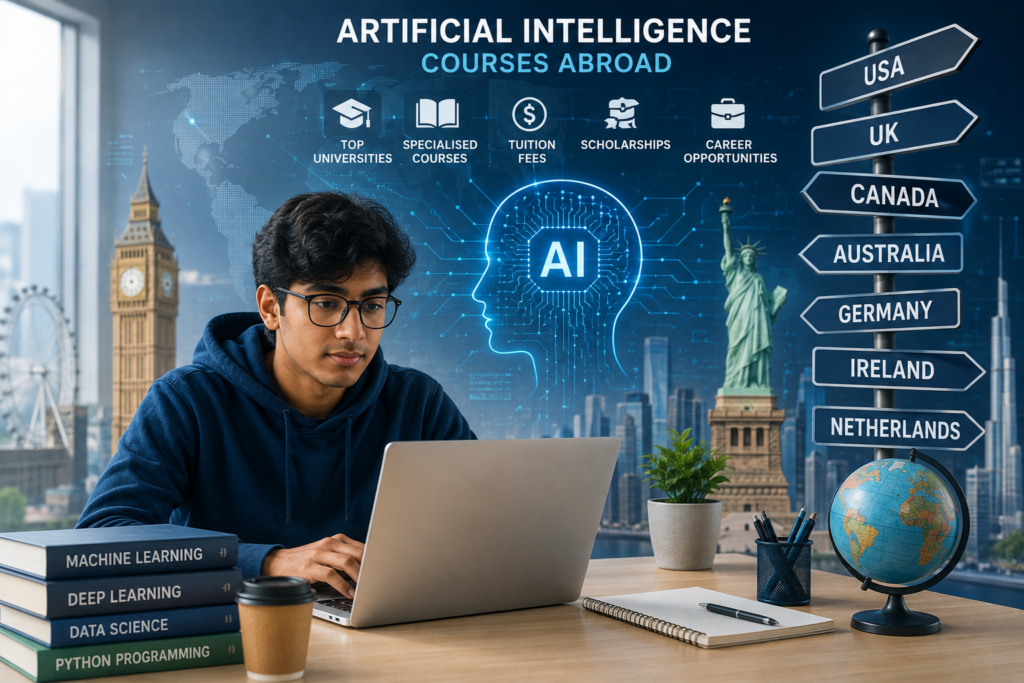
Choosing an Artificial Intelligence programme abroad can feel exciting, but it also comes with a long list of questions. Which country should you choose? How much will tuition and living costs be? Do you need a computer science background? And what kind of career can you build after graduation?
For Indian students, Artificial Intelligence courses abroad can range from undergraduate degrees after Class 12 to specialised master’s programmes after BTech, BE, BSc, BCA or MCA. This guide explains the major options, eligibility, costs, countries and career considerations so you can compare programmes before applying.
What Are Artificial Intelligence Courses?
An AI programme teaches students how to build and use systems that can learn from data, recognise patterns and support decision-making.
Depending on the programme, you may study:
- Machine learning and deep learning
- Python and other programming concepts
- Data science and statistics
- Natural language processing
- Computer vision
- Robotics
- AI model development and evaluation
An AI degree abroad is different from a short-term certification. A degree usually involves structured academic study, assessments and projects over a longer period, while a certification may focus on a specific skill or tool.
Why Study Artificial Intelligence Abroad?
Studying AI overseas can give students access to specialised courses, research environments, international classrooms and practical projects. Some programmes also allow students to combine AI with areas such as robotics, healthcare, business or computer science.
However, studying abroad is not automatically the better option for everyone. The right choice depends on your academic background, budget, preferred specialisation and career plans.
For Indian students, it is particularly important to compare the total cost, rather than looking only at tuition fees. A lower-fee programme in an expensive city may not necessarily be cheaper overall.
Best Countries to Study Artificial Intelligence
There is no single best country for every student. The UK, USA, Canada, Australia, Germany, Ireland and the Netherlands all offer AI-related study options, but programmes differ considerably between universities.
| Country | Common programme options | Typical duration* | Affordability level | Important point to verify |
|---|---|---|---|---|
| UK | AI, Computer Science, Machine Learning | Often 1 year for master’s | Medium–High | Programme structure and current visa rules |
| USA | AI, Computer Science, Data Science | Often 1–2 years for master’s | High | Tuition, funding and entry requirements |
| Canada | AI, Computer Science, Data Science | Varies | Medium–High | Current programme and study-permit requirements |
| Australia | AI, Data Science, Computer Science | Varies | Medium–High | Tuition, location and visa conditions |
| Germany | AI, Computer Science, Robotics | Varies | Low–Medium at some public institutions | Programme-specific fees and language |
| Ireland | AI, Computing, Data Science | Varies | Medium–High | Programme fees and entry requirements |
| Netherlands | AI, Computer Science, Data Science | Varies | Medium–High | Programme language and admission criteria |
*Duration and affordability vary by university, programme and city. Always check the current programme page before making a decision.
Visa and post-study work rules can also change. For example, UK Student visa requirements and post-study options are subject to current government rules. Australia similarly provides current Student visa information through its Department of Home Affairs.
Popular AI Programmes Abroad
Students can choose from several related study paths.
Bachelor’s in Artificial Intelligence
Suitable for students who have completed Class 12, usually with the required mathematics or science background specified by the university. Some programmes are offered as dedicated AI degrees, while others place AI within computer science.
Master’s in Artificial Intelligence
A common choice for BTech, BE, BSc, BCA, MCA and related graduates. Some universities expect previous study in computing, mathematics, engineering or a closely related discipline.
Machine Learning
This focuses more deeply on algorithms and systems that learn from data. It can be a good choice for students interested in technical AI development.
Data Science and AI
This combines data analysis, statistics, programming and AI techniques. It may suit students who want to work across both data and machine learning.
Robotics and Intelligent Systems
A useful option for students interested in combining AI with robotics, automation, sensors and intelligent machines.
Other pathways include Computer Science with an AI specialisation and Business Analytics with AI.
Eligibility Requirements for AI Courses Abroad
There is no universal eligibility for AI courses abroad. Requirements depend on the university, qualification level and programme.
Common requirements may include:
- Relevant academic qualifications
- Mathematics and/or programming knowledge
- Academic transcripts
- Proof of English proficiency
- IELTS or another accepted English-language test, where required
- Statement of purpose
- Letters of recommendation for some postgraduate programmes
- GRE or other tests, where applicable
- Projects, portfolio or work experience for selected programmes
If you are planning to study Artificial Intelligence abroad after BTech, check whether your undergraduate subjects meet the programme’s prerequisite requirements. A BTech in Computer Science may be directly relevant to some programmes, while applicants from other disciplines may need specific mathematics, programming or computing credits.
Artificial Intelligence Course Fees and Living Costs
The cost of studying AI abroad depends on several factors:
- Tuition fees
- Accommodation
- Food and transportation
- Health insurance
- Visa and application charges
- Laptop, software and academic expenses
There is no single figure that represents Artificial Intelligence course fees abroad. Even within the same country, costs can differ substantially between universities, cities and programme types.
Instead of choosing a course based only on tuition, calculate the estimated total cost for the full study period. You should also check whether the programme is one year or two years, as duration can significantly affect your overall budget.
CourseFind.app can help you compare programmes and review current course information before creating your shortlist.
Scholarships and Funding Options
Funding possibilities may include:
- University merit scholarships
- Need-based financial support
- Government-funded scholarships
- External scholarship programmes
- Education loans
- University-specific tuition reductions
Scholarship eligibility, coverage and deadlines vary. Some awards may cover only part of tuition, while others can provide broader financial support.
If you are searching for Artificial Intelligence scholarships for Indian students, always verify the current eligibility criteria and deadline directly with the university or official scholarship provider.
Career Opportunities After an AI Degree
An AI qualification can lead to different technical and analytical roles, depending on your specialisation and experience.
Possible career paths include:
- Machine Learning Engineer
- AI Engineer
- Data Scientist
- Computer Vision Engineer
- NLP Engineer
- Robotics Engineer
- AI Product Analyst
- Research Assistant
A degree alone does not determine your career outcome. Employers may also look for programming ability, Python, SQL, mathematics and statistics, model evaluation, cloud technologies, communication skills and practical projects.
Building a portfolio can be particularly useful. For example, a student could develop a computer vision project, create a natural language processing application or build a machine learning model using a real-world dataset.
Internships, research experience and project work can also help you demonstrate what you can actually do.
How to Choose the Right AI Course Abroad
Before applying, compare each programme using this checklist:
- Curriculum: Does it cover the AI areas you want to study?
- Specialisations: Are machine learning, robotics, NLP or computer vision available?
- Entry requirements: Do your academic qualifications match?
- Total cost: Consider tuition and living expenses together.
- Location: Does the city fit your budget and lifestyle?
- Projects and internships: Look for practical learning opportunities.
- Duration: Compare one-year and longer programmes carefully.
- Intakes: Check whether your preferred intake is currently available.
- Scholarships: Review eligibility and deadlines.
- Post-study work options: Check the latest official government rules.
- Career support: Review what the university actually provides.
How CourseFind.app Can Help
Finding an AI programme can become confusing when every university presents its information differently. CourseFind.app helps students discover and compare courses using practical details such as country, tuition fees, duration, intake and admission requirements.
You can start by Explore Artificial Intelligence courses abroad and shortlist programmes that match your academic background and budget.
You can also Explore Computer Science and IT programmes if you are considering AI as part of a broader computing degree.
Before applying, verify the latest programme requirements directly with the university. For visa information, use official government sources such as the UK Student visa guidance and Australia Student visa information. UK requirements, including required documents and visa conditions, can change, so applicants should rely on the current official guidance.
Conclusion
Choosing among Artificial Intelligence courses abroad is not simply about finding a famous university. The better approach is to match the programme with your academic background, preferred AI specialisation, budget and long-term career plans.
Compare curriculum, tuition fees, living costs, entry requirements, intakes, scholarships and post-study options before making a decision. Most importantly, verify current information with the university and relevant government authorities.
Once you understand what you need, use CourseFind.app to discover and compare suitable AI programmes and create a practical shortlist.
FAQs
1. Which country is best for Artificial Intelligence courses abroad?
There is no universally best country. The UK, USA, Canada, Australia, Germany, Ireland and the Netherlands offer different advantages in areas such as programme choice, research, cost and industry exposure. Your academic and financial priorities should guide the decision.
2. Can I study Artificial Intelligence abroad after BTech?
Yes, many AI master’s programmes accept graduates from relevant engineering and computing backgrounds. However, prerequisites differ, so check the specific programme’s mathematics, programming and academic requirements.
3. What are the common requirements for a Master’s in AI abroad?
Common requirements can include a relevant bachelor’s degree, academic transcripts, mathematics or programming knowledge, English-language proficiency and application documents such as an SOP. Some programmes may have additional requirements.
4. How much does an Artificial Intelligence course abroad cost?
There is no standard cost. Tuition and living expenses vary by country, university, city, programme and duration. Compare the complete cost rather than tuition alone.
5. Are scholarships available for Indian students studying AI abroad?
Yes, funding may be available through universities, governments and external organisations. Eligibility and coverage vary, so check each scholarship’s current official requirements and deadline.