
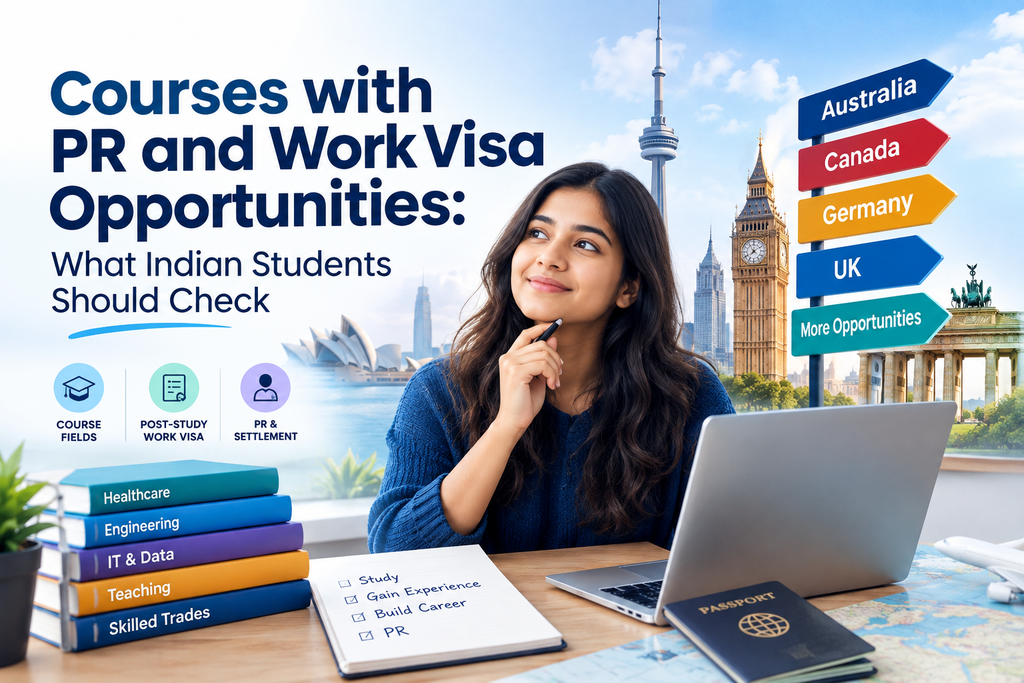
No course can promise a visa, a job or permanent residency. What you can do is research courses with PR and work visa opportunities more realistically. Look for programmes that connect to skilled occupations, then check whether each country’s current rules let graduates in that area work after study. Eligibility depends on government rules at the time, your qualification, your institution, your occupation and your own circumstances. This guide is for Indian students comparing study abroad courses and post-study work visa options.
How courses connect to post-study work and skilled migration
Two ideas often get mixed up. A post-study work permission is a temporary right to stay and work after graduating. Permanent residency (PR) or settlement is a separate, longer-term status with its own requirements. A graduate or job-search permit is not PR.
Your course matters because many systems look at what you studied, where you studied, or which occupation you work in. Canada’s graduate work permit, for example, requires completing a programme of at least eight months at an eligible designated learning institution. Australia publishes a skilled occupation list showing which occupations can apply for certain skilled visas.
Courses with PR and work visa opportunities: fields to research
These fields are worth investigating for skilled-career pathways:
- Healthcare and nursing: often regulated, so professional registration may be needed. Germany’s official portal says a licence to practise is required for regulated professions.
- Engineering: check whether your qualification and target occupation are recognised in your chosen country.
- IT, computing and data-related fields: job titles vary, so see how official occupation lists describe the work, not just how the course is named.
- Teaching: rules differ widely. In Canada’s field-of-study list, some education programmes qualify only depending on when you applied.
- Selected skilled trades: vocational routes may be treated differently from degrees, so check programme-level rules.
Not every course in these fields is eligible in every country. Courses with PR and work visa opportunities in one destination may not qualify in another, so check each country separately.
Compare official post-study pathways by destination
Use this table to verify the rules behind courses with PR and work visa opportunities in four popular destinations.
| Destination | What graduates should verify | Official source |
|---|---|---|
| Australia | Whether your target occupation is on the relevant skilled occupation list, which visa it applies to, and whether a skills assessment by the named assessing authority is needed | Department of Home Affairs: Skilled occupation list |
| Canada | A programme of at least 8 months at an eligible institution, full-time study, and a language level (CLB 7 for bachelor’s, master’s or doctoral; CLB 5 for college programmes). Non-degree programmes may also need an eligible field of study if the study permit was applied for on or after 1 November 2024 | IRCC: Who can apply; Field of study |
| Germany | A residence permit of up to 18 months to look for qualified work (not renewable), with proof of completed studies, health insurance and means to support yourself. A licence is needed for regulated professions | Federal Government: Prospects after graduation |
| UK | The Graduate visa lasts 2 years if you apply on or before 31 December 2026 and 18 months on or after 1 January 2027 (3 years for doctorates). Your provider must confirm you completed the course | GOV.UK: Graduate visa overview |
All of these are temporary permissions, and none is PR. The UK Graduate visa cannot be extended, though holders may be able to switch to another visa, such as a Skilled Worker visa. Germany’s job-search permit is not renewable. Rules were checked in October 2026 and may change, so always confirm the live page.
How to choose courses with PR and work visa opportunities
- Start with the occupation, not the course title. Courses leading to skilled jobs abroad are easier to research when they map to a named occupation.
- Read the official rules before comparing fees or rankings. Visa conditions can change what a course is worth to you.
- Match the course level to the rules. Canada treats degree graduates and other programme graduates differently, as the table shows.
- Plan for what comes next. Post-study permits are temporary, so ask what your next step would be, such as a job offer in a skilled role.
- Keep a financial buffer. A job search can take longer than expected.
CourseFind.app can help you discover and compare courses in one place. Use it to build a shortlist of courses with PR and work visa opportunities to research further, then confirm each one on official government and university pages.
Final checklist before applying
- The institution and course are officially approved for international students in that country.
- You have read the current post-study visa rules on the government website, including any changes with start dates.
- You have checked field-of-study or occupation requirements for your target pathway.
- Accreditation or licensing is confirmed if you plan to enter a regulated profession.
- You have read the university’s official course page for duration, study mode and entry requirements.
- You have noted any language requirements for the work permit, not just for admission.
- You will re-check the rules shortly before you apply.
Quick FAQ
Is a post-study work visa the same as PR? No. A post-study permit is temporary. PR or settlement has separate eligibility rules set by each government.
Ready to compare?
Start your shortlist of courses with PR and work visa opportunities. Explore courses on CourseFind.app, compare programmes that match your goals, and verify each one against official sources before you apply.
Official Sources
- Skilled occupation list, Department of Home Affairs (Australian Government): https://immi.homeaffairs.gov.au/visas/working-in-australia/skill-occupation-list
- Post-graduation work permit: Who can apply, Immigration, Refugees and Citizenship Canada (Government of Canada): https://www.canada.ca/en/immigration-refugees-citizenship/services/study-canada/work/after-graduation/eligibility.html
- Post-graduation work permit: Field of study requirement, Immigration, Refugees and Citizenship Canada (Government of Canada): https://www.canada.ca/en/immigration-refugees-citizenship/services/study-canada/work/after-graduation/eligibility/field-of-study.html
- Prospects after graduation, Make it in Germany (German Federal Government portal): https://www.make-it-in-germany.com/en/study-vocational-training/studies-in-germany/prospects-after
- Graduate visa: Overview, GOV.UK (UK Government): https://www.gov.uk/graduate-visa/overview