
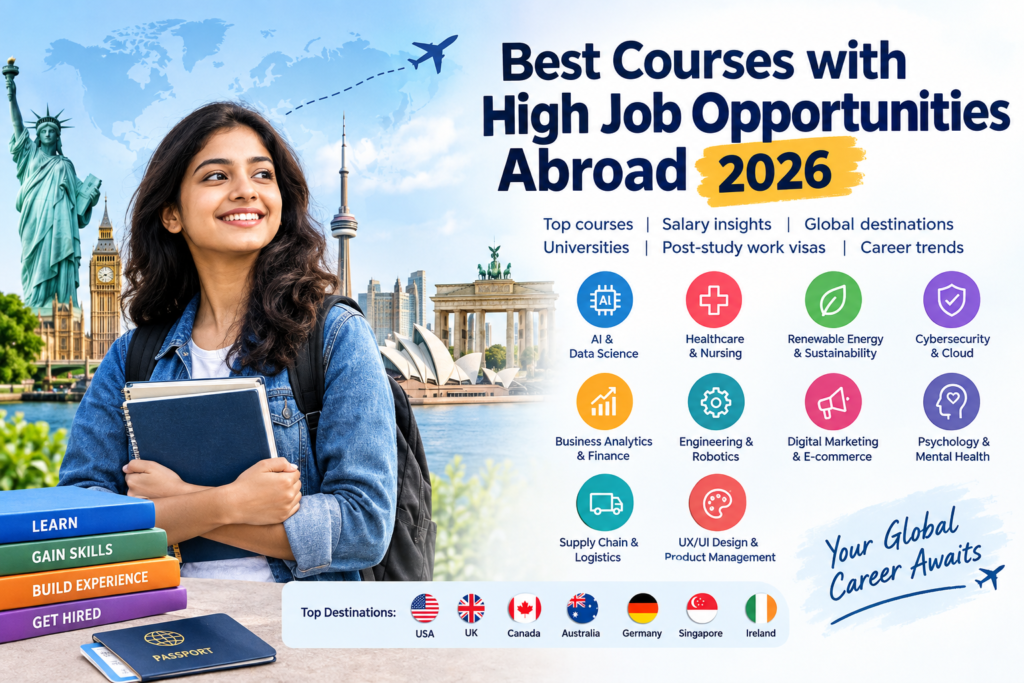
Choosing a course in 2026 is about more than getting a degree. If your goal is to study abroad and build a career overseas, you need to think about job demand, salary potential, skills, immigration rules, and post-study work options before applying.
The best courses with high job opportunities abroad 2026 are increasingly connected to technology, healthcare, sustainability, cybersecurity, engineering, business intelligence, and specialised digital skills.
For example, the US Bureau of Labor Statistics reports a 2025 median salary of $120,230 for data scientists, $129,180 for information security analysts, and $97,550 for registered nurses. Software developers had a 2025 median salary of $135,980.
So, which courses should Indian students consider?
Here, you’ll find:
- 10 high-demand courses to consider in 2026
- Salary examples and leading study destinations
- University examples for each subject
- Post-study work visa information
- Country-wise opportunities across the USA, UK, Canada, Australia, Germany, Singapore and Ireland
- Important 2026 trends that could affect your career
Important: A high-demand course does not automatically guarantee employment. Your university, skills, internships, work experience, communication ability and local licensing requirements can all affect your job prospects.
Top 10 Most In-Demand Courses in 2026
The best courses with high job opportunities abroad 2026 are not limited to computer science. Healthcare, green energy, engineering, finance, logistics and design are also creating opportunities in different markets.
1. Data Science & Artificial Intelligence
AI has moved from being a specialised technology to becoming part of everyday business. Companies now use data and AI for marketing, finance, healthcare, manufacturing, cybersecurity and product development.
The US BLS reported a 2025 median annual wage of $120,230 for data scientists, with demand supported by increasing use of data-driven decision-making.
Typical salary:
- USA: around $90,000–$160,000+
- UK: around £40,000–£85,000
- Germany: around €50,000–€90,000
- Rough equivalent: ₹75 lakh–₹1.3 crore+ at higher US salary levels
Popular countries: USA, UK, Germany
University examples:
- MIT
- Stanford University
- University of Oxford
QS 2026 places MIT at the top for Computer Science & Information Systems, with Stanford and Carnegie Mellon also among the leading universities.
Entry requirements: A relevant bachelor’s degree, mathematics/statistics or programming background, English proficiency and, for some postgraduate programs, GRE or GMAT depending on the university.
Post-study work: US graduates may use OPT, with eligible STEM graduates potentially receiving a 24-month STEM OPT extension. Germany offers up to 18 months to look for qualified employment after graduation.
2. Nursing & Healthcare Management
Healthcare remains one of the strongest areas for international employment because populations are ageing and healthcare systems need qualified professionals.
The US BLS recorded a $97,550 median annual wage for registered nurses in May 2025, with about 180,800 RN openings projected annually on average over 2025–2035.
Typical salary:
- USA: $75,000–$120,000+
- UK: £30,000–£55,000+
- Australia: AUD 75,000–110,000+
- Rough equivalent: ₹60 lakh–₹1 crore+ at the higher end
Popular countries: Australia, UK, USA
University examples:
- University of Pennsylvania
- King’s College London
- University of Melbourne
Entry requirements: Nursing degrees usually require science subjects and English-language proficiency. Registered nursing is a regulated profession, so graduates may need country-specific registration, examinations or competency assessment.
Post-study work: Australia’s Temporary Graduate visa Post-Higher Education Work stream generally allows eligible graduates to remain for around 2–3 years depending on qualification.
3. Renewable Energy & Sustainability
The global shift towards cleaner energy is creating new roles in renewable power, environmental consulting, energy systems, sustainability reporting and climate technology.
The OECD’s recent labour-market research identifies the green transition and decarbonisation as structural forces affecting labour shortages and skills demand.
Typical salary:
- USA: $70,000–$130,000+
- Germany: €45,000–€85,000
- UK: £35,000–£70,000
Popular countries: Germany, Australia, UK
University examples:
- ETH Zurich
- Imperial College London
- Technical University of Munich
QS 2026 ranks MIT, Stanford and ETH Zurich among the leading institutions in Engineering & Technology.
Entry requirements: Physics, mathematics or engineering backgrounds are useful. English proficiency is generally required for English-taught programs; German language skills can be valuable for employment in Germany.
Post-study work: Germany offers international graduates up to 18 months to search for qualified employment after completing their studies.
4. Cybersecurity & Cloud Computing
Every organisation that uses digital systems also needs to protect them. That makes cybersecurity one of the most relevant technology specialisations for 2026.
US BLS data puts the 2025 median salary for information security analysts at $129,180, with employment projected to grow 21% from 2025 to 2035.
Typical salary:
- USA: $90,000–$160,000+
- UK: £40,000–£90,000
- Germany: €50,000–€95,000
Popular countries: USA, UK, Germany
University examples:
- Carnegie Mellon University
- University of Oxford
- ETH Zurich
Entry requirements: Computer science, IT, mathematics or engineering backgrounds are commonly accepted. Some programs may request programming experience, GRE scores or relevant professional certifications.
Post-study work: STEM graduates in the US may qualify for the additional 24-month STEM OPT extension if they meet the relevant requirements.
5. Business Analytics & Finance
Businesses need people who can understand numbers and turn them into decisions. That is why business analytics sits between traditional business education and technology.
Students can move into roles such as business analyst, financial analyst, risk analyst, data analyst and consulting associate.
Typical salary:
- USA: $65,000–$130,000+
- UK: £35,000–£80,000
- Ireland: €40,000–€75,000
Popular countries: USA, UK, Ireland
University examples:
- University of Pennsylvania
- London Business School
- Trinity College Dublin
Entry requirements: A bachelor’s degree, mathematics/statistics knowledge and English proficiency are common. GMAT or GRE may be required for selected master’s or MBA programs.
Post-study work: Ireland’s Third Level Graduate Programme provides up to 12 months for eligible Level 8 graduates and can provide up to 24 months for eligible Level 9 or higher graduates, subject to its conditions.
6. Mechanical & Robotics Engineering
Robotics is no longer limited to research laboratories. Manufacturing, automotive companies, logistics businesses and healthcare organisations increasingly use automation and robotics.
QS 2026 lists MIT as the leading institution in Engineering & Technology, followed by other globally recognised institutions including Stanford and ETH Zurich.
Typical salary:
- USA: $70,000–$130,000+
- Germany: €45,000–€85,000
- Australia: AUD 75,000–115,000+
Popular countries: Germany, USA, Australia
University examples:
- MIT
- Stanford University
- ETH Zurich
Entry requirements: Mathematics and physics are important for most engineering programs. Some robotics master’s degrees also expect programming, electronics, control systems or mechanical engineering knowledge.
Post-study work: Germany offers an 18-month job-search residence permit to eligible international graduates.
7. Digital Marketing & E-commerce
Not every high-demand career requires advanced mathematics or coding.
Digital marketing, e-commerce, SEO, paid advertising, social media, content strategy and marketing analytics remain useful across industries because businesses increasingly depend on digital customer acquisition.
Typical salary:
- USA: $50,000–$100,000+
- UK: £30,000–£65,000
- Australia: AUD 60,000–100,000+
Popular countries: UK, Australia, Canada
University examples:
- University of Southern California
- University of Warwick
- University of Melbourne
Entry requirements: Many programs accept students from different academic backgrounds. English proficiency is normally required, while portfolios, internships and practical digital marketing experience can strengthen employability.
Post-study work: In the UK, eligible graduates applying on or before 31 December 2026 can receive a two-year Graduate visa; applications from 1 January 2027 receive 18 months, while doctoral graduates receive three years.
8. Psychology & Mental Health Counseling
Mental health services are becoming a larger part of healthcare and community services. Psychology can therefore offer career opportunities in counselling, behavioural health, education, research and organisational settings.
However, this field comes with an important difference: many clinical roles require professional registration or licensing.
Typical salary:
- USA: $55,000–$100,000+
- UK: £30,000–£60,000+
- Australia: AUD 70,000–110,000+
Popular countries: USA, Australia, UK
University examples:
- Harvard University
- University of Melbourne
- University College London
Entry requirements: Psychology degrees may require academic prerequisites and English proficiency. Clinical practice usually requires additional qualifications, supervised training and registration.
Post-study work: Visa duration depends on the destination and qualification. Always check the current immigration rules before choosing a psychology program.
9. Supply Chain & Logistics Management
Think about everything that happens before an online order reaches your doorstep. Warehousing, transportation, inventory, procurement and international trade all depend on supply-chain professionals.
The growth of e-commerce and international manufacturing has made supply chain an increasingly technology-driven field.
Typical salary:
- USA: $60,000–$120,000+
- UK: £35,000–£70,000
- Canada: CAD 60,000–100,000+
Popular countries: Canada, USA, Germany
University examples:
- Massachusetts Institute of Technology
- University of British Columbia
- Technical University of Munich
Entry requirements: Business, engineering, economics or related degrees can be useful. Some master’s programs accept students from broader backgrounds.
Post-study work: Canada’s PGWP can range from 8 months to as much as 3 years depending on the program and eligibility. For bachelor’s, master’s and doctoral graduates, Canada currently does not impose a field-of-study requirement for PGWP eligibility, although language requirements apply.
10. UX/UI Design & Product Management
Technology companies need professionals who understand not only how a product works, but also how people experience it.
UX/UI design can lead to careers in interface design, UX research, interaction design and product design. Product management adds business, technology and customer strategy to the mix.
Typical salary:
- USA: $70,000–$140,000+
- UK: £40,000–£90,000
- Germany: €45,000–€85,000
Popular countries: USA, UK, Germany
University examples:
- Stanford University
- Carnegie Mellon University
- University College London
Entry requirements: A strong portfolio is often more important than a GRE score for design-focused courses. Product management programs may prefer candidates with business, technology or professional experience.
Post-study work: Visa options depend on the destination and course. For example, eligible UK graduates can use the Graduate route under the current rules.
For students exploring creative pathways, you can also compare arts and design courses abroad.
Best Courses for Jobs in USA, UK, Canada, Australia, Germany, Singapore and Ireland
The same course can have very different career prospects depending on the country. Your decision should therefore consider both the course and the local labour market.
| Country | High-demand course areas | Indicative salary range | Post-study option |
|---|---|---|---|
| USA | AI, Data Science, Cybersecurity | $70k–$160k+ | OPT; eligible STEM degrees can qualify for additional 24 months |
| UK | Healthcare, Data, Finance | £30k–£90k+ | Graduate visa: 2 years if applied by Dec 31, 2026; 18 months from Jan 1, 2027 |
| Canada | Healthcare, IT, Supply Chain | CAD 55k–120k+ | PGWP can be up to 3 years depending on eligibility |
| Australia | Nursing, Engineering, IT | AUD 65k–120k+ | Temporary Graduate visa generally 2–3 years depending on qualification |
| Germany | Engineering, AI, Renewable Energy | €45k–€95k+ | Up to 18 months to seek qualified employment |
| Singapore | Technology, Finance, Business Analytics | SGD 45k–100k+ | Employment generally requires an appropriate work pass |
| Ireland | Data, Pharma, Finance | €40k–€90k+ | Third Level Graduate Programme: up to 12–24 months depending on qualification |
These figures are indicative market ranges, not guaranteed starting salaries. Experience, location, employer, specialisation and professional registration can make a significant difference.
USA
For Indian students interested in technology, the US remains a major destination for AI, data, software and cybersecurity. The BLS reported 2025 median pay of $135,980 for software developers and $129,180 for information security analysts.
The main post-study route for F-1 students is OPT. Eligible STEM graduates can potentially receive an additional 24-month STEM OPT extension.
UK
Healthcare, technology, finance, engineering and business analytics are common choices.
The UK Graduate route currently provides two years for applications submitted by 31 December 2026 and changes to 18 months for applications from 1 January 2027. PhD graduates continue to receive three years.
Canada
Canada remains relevant for healthcare, technology, engineering, business and supply-chain programs.
The PGWP can last between eight months and three years depending on the course and eligibility. Current rules also include language requirements, while bachelor’s, master’s and doctoral graduates do not have a field-of-study requirement.
Australia
Australia is particularly relevant for nursing, healthcare, engineering and technology.
The Temporary Graduate visa Post-Higher Education Work stream generally provides around two to three years depending on the qualification.
Indian nationals can have specific stay periods under the Australia-India Economic Cooperation and Trade Agreement, so applicants should check the latest official rules before planning their study route.
Germany
Germany is especially interesting for engineering, renewable energy, manufacturing, robotics and technology.
International graduates can generally apply for a residence permit allowing up to 18 months to search for qualified employment after graduation.
German language skills are not always mandatory for English-taught degrees, but they can significantly expand the number of jobs you can target.
Singapore
Singapore has strong sectors in technology, finance, logistics and business.
However, Singapore does not offer a simple universal graduate work visa equivalent to the UK Graduate route. Once a Student’s Pass expires, graduates generally need an appropriate work pass to continue working.
Ireland
Ireland is worth considering for students targeting technology, finance, pharmaceuticals and business roles.
The Third Level Graduate Programme allows eligible Level 8 graduates up to 12 months and eligible Level 9+ graduates up to 24 months, subject to the programme’s requirements.
You can explore study in Ireland jobs if Ireland is one of your target destinations.
What Has Changed in 2026?
1. AI is changing almost every career
AI is not only creating AI engineer jobs. It is changing what employers expect from analysts, marketers, designers, finance professionals and managers.
The OECD’s 2026 research notes that AI is transforming labour markets and changing the skills workers need, while also creating potential productivity and employment opportunities.
That means learning to work with AI can be valuable even if your degree is not an AI degree.
2. Hybrid and remote work are changing career planning
Some jobs can now be performed across locations, but that does not mean every graduate can immediately work remotely from anywhere.
Employers still look for communication skills, practical experience, digital tools and measurable results.
For students, this makes internships and project portfolios increasingly useful.
3. Green careers are expanding
Renewable energy, energy efficiency, environmental engineering and sustainability are becoming part of mainstream business planning.
The OECD identifies decarbonisation and the green transition as important structural forces influencing labour-market demand.
4. Skills matter as much as the degree title
A degree in Data Science is useful, but employers may still expect Python, SQL, cloud platforms, statistics and communication skills.
Similarly, a Digital Marketing graduate can strengthen their profile with SEO, Google Analytics, paid advertising, content strategy and conversion optimisation.
In 2026, think beyond:
Degree → Job
A more realistic pathway is:
Degree → Skills → Projects → Internship → Job
Frequently Asked Questions
1. Which are the best courses with high job opportunities abroad 2026?
Technology, healthcare, engineering, renewable energy, cybersecurity, business analytics and supply-chain management are among the major areas worth exploring. However, demand varies by country and occupation. You should compare the specific course, job market and immigration pathway before applying.
2. Which course is best for getting a job abroad?
There is no single course that guarantees employment abroad. Your choice should depend on your academic background, career goals, budget, destination and professional licensing requirements. Courses linked to occupations experiencing strong demand can improve your options, but employability still depends on your skills and experience.
3. Which courses have the highest salaries abroad?
Technology-related roles such as software development, data science and cybersecurity can offer high salaries in markets such as the US. Healthcare professionals and specialised engineers can also earn strong salaries. Actual pay depends heavily on experience, location, employer and professional registration.
4. Which courses are good for Indian students after 12th?
Students can consider nursing, engineering, computer science, data science, business, finance, design and other subjects depending on their stream and interests. Science students may have more options in healthcare and engineering, while commerce students may consider finance, analytics or business. Always check individual university entry requirements.
5. Which countries offer post-study work opportunities in 2026?
The USA, UK, Canada, Australia, Germany and Ireland all have post-study or graduate employment pathways, but the rules differ significantly. The UK Graduate route, Australia’s Temporary Graduate visa, Canada’s PGWP, Germany’s graduate job-search residence permit and Ireland’s Third Level Graduate Programme have different eligibility requirements.
6. Can I get a job abroad after a one-year master’s?
Yes, it can be possible, but it depends on the country, qualification and immigration rules. A one-year master’s does not automatically lead to employment or permanent residence. Check whether your exact program qualifies for the destination’s post-study work route before paying your tuition deposit.
7. Is IELTS required for studying abroad in 2026?
IELTS is not universally mandatory. Some universities accept alternatives such as TOEFL, PTE, Duolingo English Test or previous education in English, depending on their policies. Always verify the English-language requirement for your specific university and visa application.
8. Are STEM courses better for getting jobs abroad?
STEM qualifications can provide strong opportunities in technology, engineering, data and science-related sectors. In the US, eligible STEM graduates can also benefit from the additional STEM OPT extension. But “STEM” alone does not guarantee a job, and non-STEM fields such as nursing, finance, logistics and design can also offer strong career pathways.
9. Which courses are suitable for students who do not want coding?
Nursing, healthcare management, finance, supply chain, digital marketing, psychology and some design programs can be suitable depending on your background and career goals. Some of these careers still use technology heavily, but advanced programming is not necessarily the core skill. Look at the actual modules before choosing a course.
10. How can I compare thousands of courses abroad?
Start by comparing the country, university, tuition fees, entry requirements, scholarships, course duration and career options. You can use search thousands of courses worldwide to explore and compare programs across different destinations.
Final Thoughts
The best courses with high job opportunities abroad 2026 are the ones that match three things: what employers need, what you are good at, and where you want to build your career.
AI, cybersecurity, data science, nursing, renewable energy, engineering, business analytics and supply chain are all worth researching. But don’t choose a course only because someone calls it “high demand.” Check the curriculum, university, total cost, salary potential, professional licensing and post-study work rules.
You can also explore fully funded scholarships 2026 before finalising your budget.
Ready to compare your options?
Start searching for your course on coursefind.app now.
Click here to find your dream course